Contract for Deed vs Deed of Trust in Texas: 3 Scenarios Side by Side, With an Equity Example
Unrecorded contract, recorded contract and a deed at closing with a Deed of Trust: who holds title, what the record shows, what happens if you stop paying, your equity in numbers and a judgment against the seller.
Rodrigo Blanco, Founder & CEO of TerraFunded
Published: 2026-11-14 · Updated: 2026-11-14
Contract for deed vs deed of trust in Texas: what's the real difference? With a contract for deed, the deed comes at the end: while the contract is unrecorded, the seller keeps legal title, and once it's recorded, Texas law treats it like a deed with a vendor's lien. With seller financing secured by a deed of trust, the deed is signed at closing, and the seller keeps a lien until the note is paid. This guide puts three scenarios side by side, shows what the public record says in each, what happens if you stop paying, a numeric illustration of your equity, and what happens if a creditor sues the seller. General information, not legal advice: before you sign, talk to a Texas real estate attorney.
This page goes with our video on the same question. Checked on November 13, 2026. Ver esta página en español.
Every one of our sales uses a deed at closing with a Deed of Trust. Call or text Andy at (214) 306-8153. Se habla español. · See every tract with its full terms
One condition first
Most contract-for-deed protections are in Texas Property Code Chapter 5, Subchapter D. Under Section 5.062 they apply only when the property is, or will be, the buyer's residence or a close relative's, with exceptions, and a lease with an option to buy gets fewer of them. If the land isn't a home, the contract's own terms and general law decide much more. Our page on what a contract for deed is explains the condition in detail.
Three scenarios side by side
| A. Unrecorded contract for deed | B. Recorded contract for deed | C. Deed at closing + Deed of Trust | |
|---|---|---|---|
| Who holds legal title | The seller | Treated like a deed with a vendor's lien (5.079) | You, from closing |
| What the public record shows | The seller as owner | Your contract | The deed in your name and the seller's lien |
| If you stop paying | 30 days to cure, then possible forfeiture (under 40% or 48 payments) | At least 60 days, then a trustee sale; any surplus is yours (5.066) | Foreclosure under Section 51.002 |
| Who gains or loses if the value changes | Depends on the contract | Depends on the contract | You |
| Path to a recorded deed | Convert under 5.081 or finish paying | Convert under 5.081 or finish paying | Already done at closing |
The seller has to record a contract for deed within 30 days (Section 5.076), but not every seller does.
Scenario C: three documents at closing
Here's what it looks like on one of our tracts, Moccasin, on Moccasin Bend Road north of Gatesville, in Coryell County. As of November 2026 it's listed at $130,000 cash, or $156,799 financed: $8,000 down, then $1,599 a month for 180 payments, at a 10% APR, fixed.
- The Warranty Deed. The seller conveys the land to you, with a warranty of title.
- The promissory note. Your promise to pay the balance, with the rate and the due dates.
- The Deed of Trust. It secures the note with a lien and names a trustee with the power to sell the land if the note isn't paid, under the rules of Section 51.002. The Deed of Trust is the security, not the sale.
After closing, the title company usually records the deed. An unrecorded deed still binds you and the seller, but recording protects you against later buyers and creditors, and once it's recorded you're the owner of record. An owner's title policy isn't automatic in every deal: it has to be part of the deal. With us, you receive one.
What the public record shows
Under Section 13.002, a recorded document is notice to everyone. Under Section 13.001, an unrecorded one still binds the people who signed it, but it's void against a later buyer or creditor who pays value without notice of it.
- Scenario A: the record shows the seller as owner. If the seller sells or borrows against the land, the new buyer or lender may never know about you.
- Scenario B: the record shows your contract, so anyone who checks sees your interest.
- Scenario C: the record shows the deed in your name and the seller's lien.
So the first question in any deal is: what will be recorded, and when? Then check the county records yourself.
If you stop paying
In A and B, these rules apply only when Subchapter D applies.
- Scenario A: after a written default notice, you get 30 days to cure. If you've paid less than 40% of the total and fewer than 48 monthly payments, the seller can use forfeiture: end the contract and keep what you paid.
- Scenario B: under Section 5.066, forfeiture isn't allowed once the contract is recorded. You get at least 60 days to cure; then the seller can sell your interest at a public auction through a trustee, and if the sale brings more than you owe, the extra goes to you.
- Scenario C: there's no contract to cancel. The remedy is foreclosure under Section 51.002. If the property is your residence, the servicer has to send a certified-mail default notice with at least 20 days to cure. If it isn't a residence, that section doesn't require the 20-day notice, so read what your Deed of Trust says. The notice of sale goes out at least 21 days ahead, and the sale is a public auction at the courthouse on the first Tuesday of a month, between 10 a.m. and 4 p.m.
More on this in what happens if you stop paying on owner-financed land.
Equity: a numeric illustration
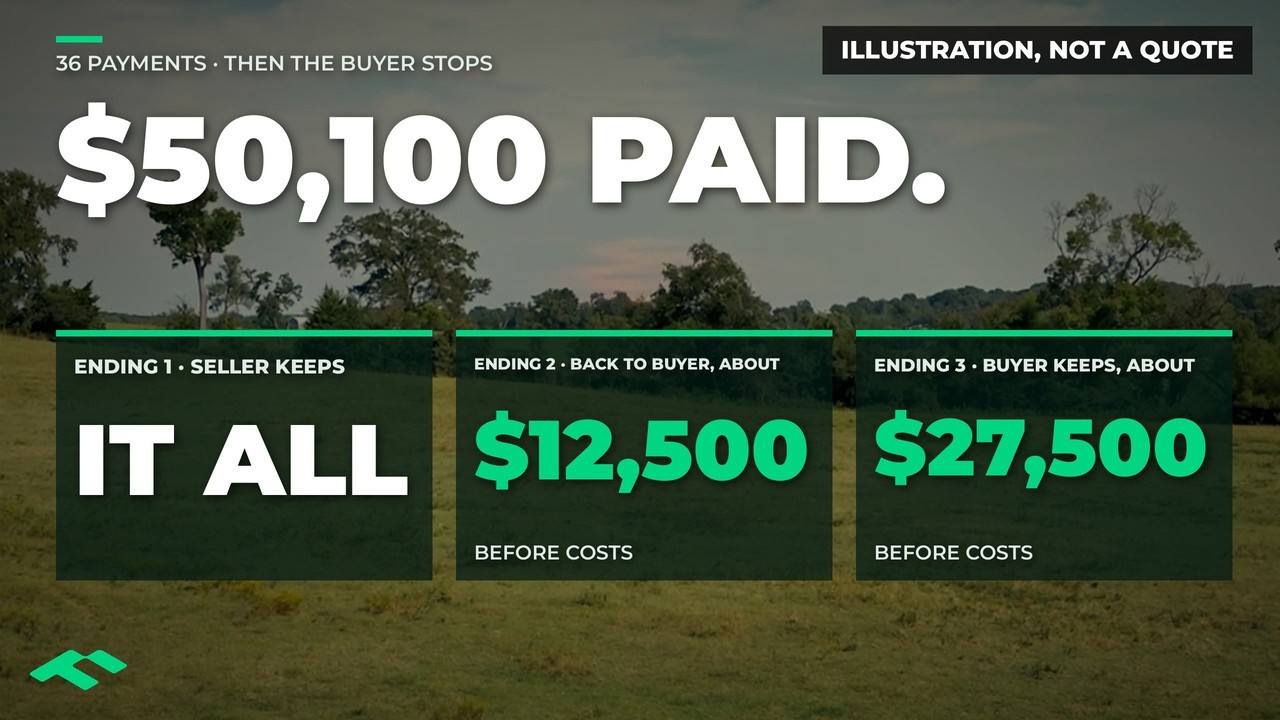
Every number here is made up: an illustration, not a quote. A buyer agrees to a $120,000 price, puts $6,000 down and finances $114,000 at an illustrative 10% over 180 payments: about $1,225 a month. After 36 payments the buyer has paid about $50,100 in total and still owes about $102,500. Say the land is now worth $130,000.
| Ending | What happens | Roughly what the buyer keeps |
|---|---|---|
| 1. Scenario A, default | Under 40% and 48 payments, forfeiture is allowed | Nothing: the seller can keep the land and the $50,100 |
| 2. Scenario B, default | At least 60 days to cure, then a trustee sale; if it brings $115,000 | About $12,500, before foreclosure costs, accrued charges and other claims |
| 3. Scenario C, the buyer sells | The title company pays off about $102,500 at $130,000 | About $27,500 before selling costs and other liens |
In ending 3, that's about $17,500 of down payment and principal plus $10,000 of higher value. If the land were worth $110,000 instead, the buyer would keep about $7,500 before costs. When you own the land, the gain or the loss is yours, and your real equity is the value minus the loan balance, the costs and any other liens. A buyer in A or B can reach ending 3 too, by converting the contract into a deed first under Section 5.081.
A judgment against the seller
Another illustration. Two years after the sale, a creditor wins a lawsuit against the seller and records an abstract of judgment in the county. Under Section 52.001, that creates a lien on real property the seller owns in that county.
- Scenario C: your Warranty Deed was recorded at closing, so the chain of title shows the land left the seller before the judgment. Generally, the lien doesn't attach to your land. What the seller still owns is the note and its lien.
- Scenario B: your recorded contract gave notice to everyone, so your interest generally comes first.
- Scenario A: the record still shows the seller as owner, and a creditor without notice of your contract may claim the land ahead of you. The law requires the seller to keep the land free of liens, and you may be able to cancel and claim your payments back, but collecting from a seller in trouble isn't guaranteed.
In every scenario, notes and contracts can be sold and servicers can change. Verify any change in payment instructions in writing with the servicer of record, and make sure the payoff and the lien release come from whoever holds the note.
Our tracts
As of November 2026, every one of our sales uses Scenario C; we don't use contracts for deed. Olney, in Young County, is listed at $99,000 cash, with $5,940 down, then $1,213 a month for 180 payments, at a 10% APR, fixed. There's no balloon payment, and closing costs are about $1,500, paid to the title company. You receive a Warranty Deed in your name at closing, at a licensed title company.
Today's inventory, from our live feed:
| Tract | County | Cash price | Financed price | Down payment | Monthly, 15 years | Monthly, 10 years |
|---|---|---|---|---|---|---|
| Wichita Falls (10 acres) | Clay | $98,000 | $117,576 | $6,000 | $1,199 | $1,474 |
| Olney (10 acres) | Young | $99,000 | $118,800 | $5,940 | $1,213 | $1,491 |
| Promised Valley (10 acres) | Young | $99,000 | $117,576 | $6,000 | $1,199 | $1,474 |
| De Kalb (10 acres) | Bowie | $110,000 | $132,000 | $6,600 | $1,348 | $1,657 |
| Marshall (10 acres) | Harrison | $110,000 | $132,000 | $6,600 | $1,348 | $1,657 |
| Linden (10 acres) | Cass | $112,500 | $135,419 | $7,000 | $1,380 | $1,697 |
| Winnsboro (10 acres) | Franklin | $120,000 | $143,701 | $7,000 | $1,469 | $1,807 |
| Franklin 1 (10 acres) | Franklin | $120,000 | $143,701 | $7,000 | $1,469 | $1,807 |
| Titus (10 acres) | Titus | $120,000 | $137,187 | $7,000 | $1,399 | $1,720 |
| Lakeview (10 acres) | Titus | $122,400 | $146,993 | $7,500 | $1,499 | $1,843 |
| Moccasin (10 acres) | Coryell | $130,000 | $156,000 | $7,800 | $1,593 | $1,958 |
Want to see the documents before you decide? Call or text Andy at (214) 306-8153. He can show you the land any day of the week.
Questions we get every week
Which is better for the buyer?
It depends on the deal, but in Scenario C you hold title from closing.
Is a deed of trust the same as a mortgage?
It does the same job, and in Texas it usually names a trustee with a power of sale.
Can a seller with a deed of trust just take the land back?
No. The seller has to follow the notice and sale rules in Section 51.002, or go to court.
What if I later want a construction loan?
The new lender will usually want the land note paid off or otherwise handled at its closing. With us, it's paid off at that loan's closing. Confirm the lender's requirements before you apply.
Do I get title insurance?
It isn't automatic: it has to be part of the deal. With us, you receive an owner's policy.
In short
The real difference is when the deed is yours: at the end with a contract for deed, at closing with a deed of trust, and recording changes the picture in between. Don't just ask whether a seller offers owner financing. Ask when you'll receive the deed, what will be recorded, and which legal process applies if you stop paying. See every tract.
Sources
- Video: Contract for Deed vs Deed of Trust Texas: 3 Scenarios Side by Side, With an Equity Example, TerraFunded, November 2026.
- Texas Property Code, Chapter 5, Subchapter D (Sections 5.062, 5.064 to 5.066, 5.076, 5.079, 5.081, 5.085): https://statutes.capitol.texas.gov/Docs/PR/htm/PR.5.htm
- Texas Property Code, Chapter 13 (Sections 13.001, 13.002): https://statutes.capitol.texas.gov/Docs/PR/htm/PR.13.htm
- Texas Property Code, Chapter 51 (Section 51.002): https://statutes.capitol.texas.gov/Docs/PR/htm/PR.51.htm
- Texas Property Code, Chapter 52 (Section 52.001): https://statutes.capitol.texas.gov/Docs/PR/htm/PR.52.htm
- TexasLawHelp.org, Contract for deed: https://texaslawhelp.org/article/contract-for-deed
- TerraFunded prices: inventory feed, https://terrafunded.com/api/properties.json, read November 13, 2026.
Related articles
- Is Owner Financing Legal in Texas? SAFE Act, Licensing, Usury and Contract for Deed
- When Do You Get the Deed With Owner Financing in Texas? Closing, Recording and Payoff
- TREC Seller Financing Addendum, Explained: Form 26-8, Paragraph by Paragraph
- Can You Buy Owner-Financed Land in Texas With Bad Credit? How Approval Really Works
- Contract for Deed in Texas: When the Law Protects You, and Your Rights Before, During and at Payoff
- Rent-to-Own Land in Texas: How It Works, What the Law Says and When You Actually Own It