Do You Need a Permit to Drill a Water Well in Texas? Permit, Registration and the Rule for Tracts Over 10 Acres
Groundwater districts, the state exemption for tracts larger than 10 acres, the construction rules that apply in every county, and one Young County tract walked through in five steps.
Rodrigo Blanco, Founder & CEO of TerraFunded
Published: 2026-11-11 · Updated: 2026-11-11
Figures checked against our inventory on November 11, 2026.
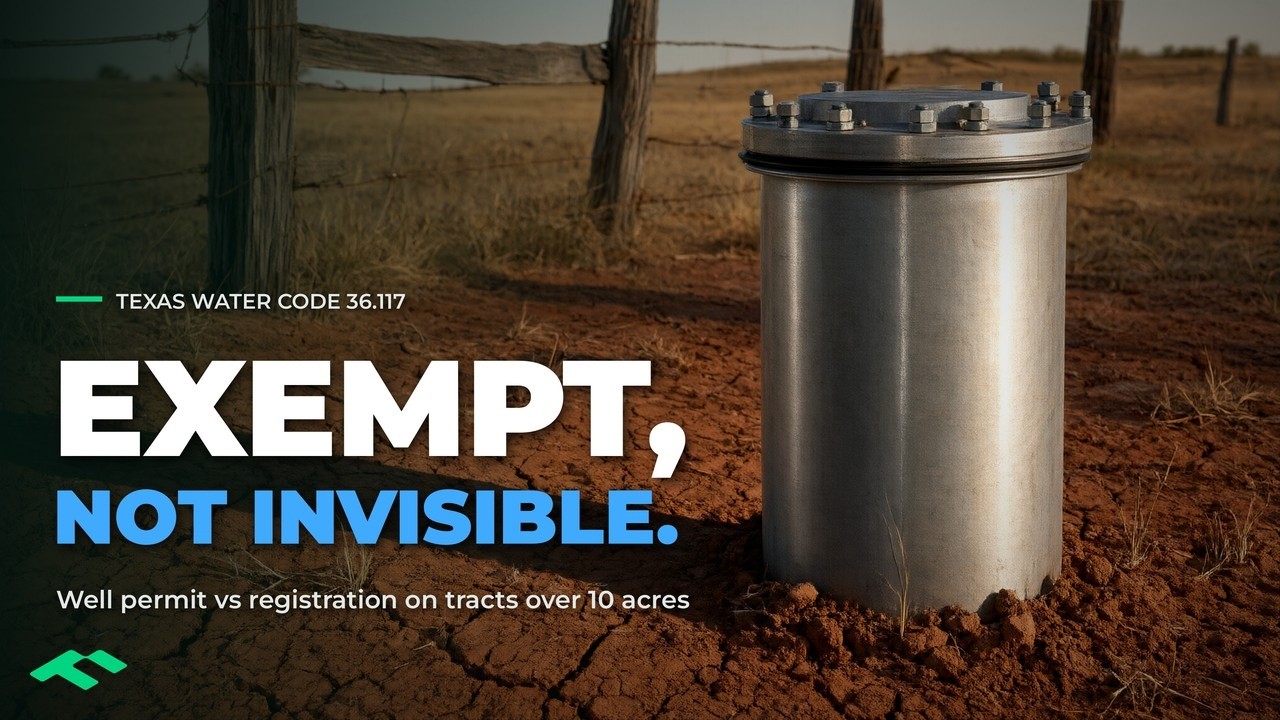
Do you need a permit to drill a water well in Texas? You may be allowed to drill a private water well without a groundwater district permit, especially on land larger than 10 acres. But you may still need to register it, follow the state's construction rules and use a licensed driller. And larger than 10 acres means more than 10: a tract of exactly 10 acres doesn't meet that test.
This page explains who regulates private wells, what the state exemption covers and what it doesn't, the rules that apply in every county, and how to check one tract from start to finish.
Watch the video
Chapters
In short
- Groundwater conservation districts, not counties, regulate private wells. Their boundaries don't always follow county lines, and 78 of the 254 Texas counties have no district on the state's map.
- A permit and a registration are two different things. A permit is the district's authorization to drill and pump. Registration is recording the well with the district. An exempt well can still have to be registered.
- The state exemption (Texas Water Code, Section 36.117) covers a well used only for domestic use, or to water livestock or poultry, on a tract larger than 10 acres, built so it can't pump more than 25,000 gallons a day.
- No permit isn't the same as water. The exemption says nothing about depth, yield, water quality or cost.
- State construction rules apply everywhere, and drilling is a licensed trade.
Is there a district on your land?
The first question is whether a groundwater conservation district covers your land (here is every Texas district, with the home wells drilled inside each one). Compare two places.
In Young County, near Olney, no district covers the county on the state's map, so no district asks for a permit or a registration for a home well.
In Gillespie County, in the Hill Country, the Hill Country district does: every well in the county has to be registered before drilling, and registering an exempt well costs $100.
It's the same kind of well with two different processes. Our free county rules map shows which case you're in for every Texas county.
The exemption, and what it still requires
Where there is a district, the state rule is in Section 36.117 of the Water Code. A district has to exempt from its permit a well that meets all of these:
- It's used only for domestic use, or to water livestock or poultry.
- It's on a tract larger than 10 acres.
- It's built so it can't pump more than 25,000 gallons a day, about 17 gallons a minute.
A district can't restrict how much water that exempt well produces. But the same law says the district has to require you to register the well, and it can require you to follow its spacing rules. So exempt from a permit doesn't mean invisible to the district. Each district also sets its own details, so read its rules. We've read them for the districts covering 120 counties so far.
No permit isn't the same as water
An exemption can't guarantee water. Whether you can drill without a permit, how deep you'll go, how much the well will yield, the water quality and the cost are five different questions. A tract can qualify for the exemption and still have a supply problem.
That's why you look at the real wells around the land before you buy. The free Texas Well Atlas shows them, with the depth, the water level and the yield their drillers reported.
The state rules, in every county
Some rules apply in every county, district or not:
- Drilling water wells is a licensed trade, regulated by the Texas Department of Licensing and Regulation (TDLR). Check a driller's license in its online search before you hire, and don't read a district exemption as permission to drill the well yourself.
- Property line: as a general rule, a well goes at least 50 feet from the property line. It can be closer only with specific construction, like special cementing, that the driller has to meet.
- Septic: at least 50 feet from a septic tank and 100 feet from a septic drain field or spray area. See our guide to septic permits on rural land.
- The report: within 60 days of finishing the well, the driller files a State Well Report and gives you a copy. Keep it.
One tract, start to finish
Here's the full check on one of our tracts near Olney, in Young County, which is at least 10.01 acres:
- District: the county rules map shows no groundwater district in Young County, so there's no district permit or registration.
- Acreage: the tract is larger than 10 acres, so a home or livestock well would also meet the state exemption's acreage test.
- Nearby wells: the Atlas shows 10 home wells within 5 miles, half of them 105 to 195 feet deep, with a median reported yield of 4 gallons a minute. You'd ask a driller whether that meets your needs.
- Site plan: the well at least 50 feet from the property lines, 50 feet from the septic tank and 100 feet from the drain field.
- Driller: a licensed driller, two quotes, and your copy of the State Well Report at the end.
In six of the seven counties where we sell land today (Young, Clay, Harrison, Cass, Franklin and Titus), there's no groundwater district on the state's map. Coryell County is in the Middle Trinity district, so check its rules.
When you will need a permit
Plan for a permit, or at least a call to the district, if:
- the well is for more than a home and animals: irrigation, a business, an RV park or selling water;
- the well can pump more than the exempt limit;
- the tract is 10 acres or less, where the district's own rules decide.
When in doubt, call the district before the driller shows up.
Land we have today
| Tract | County | Cash price | Financed price | Down payment | Monthly, 15 years | Monthly, 10 years |
|---|---|---|---|---|---|---|
| Wichita Falls (10 acres) | Clay | $98,000 | $117,576 | $6,000 | $1,199 | $1,474 |
| Promised Valley (10 acres) | Young | $99,000 | $117,576 | $6,000 | $1,199 | $1,474 |
| Olney (10 acres) | Young | $99,000 | $118,800 | $5,940 | $1,213 | $1,491 |
| Marshall (10 acres) | Harrison | $110,000 | $132,000 | $6,600 | $1,348 | $1,657 |
| Linden (10 acres) | Cass | $112,500 | $137,187 | $7,000 | $1,399 | $1,720 |
| Winnsboro (10 acres) | Franklin | $120,000 | $143,701 | $7,000 | $1,469 | $1,807 |
| Franklin 1 (10 acres) | Franklin | $120,000 | $143,701 | $7,000 | $1,469 | $1,807 |
| Titus (10 acres) | Titus | $120,000 | $137,187 | $7,000 | $1,399 | $1,720 |
| Lakeview (10 acres) | Titus | $122,400 | $146,993 | $7,500 | $1,499 | $1,843 |
| Moccasin (10 acres) | Coryell | $130,000 | $156,799 | $8,000 | $1,599 | $1,966 |
Looking at one of our tracts? Call or text Andy at (214) 306-8153. He can set up a visit any day of the week. Se habla español.
Questions we get every week
Do I need a permit for a water well on 10 acres in Texas? The state exemption is for tracts larger than 10 acres, so a tract of exactly 10 doesn't meet it. On more than 10, a home or livestock well is usually exempt from the district permit, but you may have to register it.
Does the county issue well permits? No. Groundwater districts do, where they exist.
Can I drill the well myself? Drilling is a licensed trade in Texas, and a district exemption isn't permission to drill it yourself. Ask TDLR, and in most cases, hire a licensed driller.
How far does a well have to be from a septic system? At least 50 feet from the tank and 100 feet from the drain field.
Does qualifying for the exemption mean I'll find water? No. Check the real wells nearby in the Texas Well Atlas.
Sources
- Texas Water Code, Chapter 36 (Section 36.117): https://statutes.capitol.texas.gov/Docs/WA/htm/WA.36.htm
- TDLR, drilling and installing water wells: https://www.tdlr.texas.gov/wwd/drilling-installing.htm
- District coverage and each district's rules: the county rules map, with the official source for every county.
This is general information, not legal advice. Rules change, so confirm with the district and with a licensed driller before you buy or drill.
Full video transcript
[0:01] Do you need a permit to drill a water well in Texas? You may be allowed to drill a private water well without a groundwater district permit, especially on land larger than 10 acres. But you may still need to register it, follow the state's construction rules and use a licensed driller. And larger than 10 acres means more than 10: a tract of exactly 10 acres doesn't meet that test. Here's how to know which rules apply to your property.
[0:30] This is TerraFunded, from Dallas. We've sold rural Texas land with owner financing since 2020, more than 350 transactions, and every one closes at a licensed title company.
[0:48] The first question is whether a groundwater conservation district covers your land. These districts, not counties, regulate private wells, and their boundaries don't always follow county lines. Compare two places. In Young County, near Olney, no district covers the county on the state's map, so no district asks for a permit or a registration for a home well.
[1:13] In Gillespie County, in the Hill Country, the Hill Country district does: every well in the county has to be registered before drilling, and registering an exempt well costs $100. Same kind of well, two different processes. Our free county rules map shows which case you're in for every Texas county, and 78 of the 254 have no district.
[1:42] Where there is a district, here's the state rule, in Section 36.117 of the Water Code. A district has to exempt from its permit a well used only for domestic use, or to water livestock or poultry, if it's on a tract larger than 10 acres and it's built so it can't pump more than 25,000 gallons a day, about 17 gallons a minute. A district can't restrict how much water that exempt well produces.
[2:12] But the same law says the district has to require you to register the well, and it can require you to follow its spacing rules. So exempt from a permit doesn't mean invisible to the district. Each district also sets its own details, so read its rules; we've read them for the districts covering 120 counties so far.
[2:38] Here's what an exemption can't do: guarantee water. Whether you can drill without a permit, how deep you'll go, how much the well will yield, the water quality and the cost are five different questions. A tract can qualify for the exemption and still have a supply problem. That's why you look at the real wells around the land before you buy. Our Texas Well Atlas shows them, with the depth, the water level and the yield their drillers reported.
[3:12] Some rules apply in every county, district or not. Drilling water wells is a licensed trade in Texas, regulated by the Texas Department of Licensing and Regulation. Check a driller's license in its online search before you hire, and don't read a district exemption as permission to drill the well yourself. As a general rule, a well goes at least 50 feet from the property line; it can be closer only with specific construction, like special cementing, that the driller has to meet. It also goes at least 50 feet from a septic tank and 100 feet from a septic drain field or spray area. And within 60 days of finishing the well, the driller files a State Well Report and gives you a copy. Keep it.
[3:59] Looking at one of our tracts? Andy can set up a visit any day of the week: call or text 214-306-8153.
[4:14] Let's walk through one of our tracts near Olney, in Young County, at least 10.01 acres. Step one: the county rules map shows no groundwater district in Young County, so there's no district permit or registration. Step two: the tract is larger than 10 acres, so a home or livestock well would also meet the state exemption's acreage test. Step three: the Atlas shows 10 home wells within 5 miles, half of them 105 to 195 feet deep, with a median reported yield of 4 gallons a minute, so you'd ask a driller whether that meets your needs.
[4:54] Step four: the site plan, with the well at least 50 feet from the property lines, 50 feet from the septic tank and 100 feet from the drain field. Step five: a licensed driller, two quotes, and your copy of the State Well Report at the end. In six of our seven counties, Young, Clay, Harrison, Cass, Franklin and Titus, there's no groundwater district on the state's map; Coryell County is in the Middle Trinity district, so check its rules. And every tract we sell is at least 10.01 acres.
[5:39] Plan for a permit, or at least a call to the district, if the well is for more than a home and animals: irrigation, a business, an RV park or selling water. The same goes for a well that can pump more than the exempt limit, or a tract of 10 acres or less, where the district's own rules decide. When in doubt, call the district before the driller shows up.
[6:06] Do I need a permit for a water well on 10 acres in Texas? The state exemption is for tracts larger than 10 acres, so a tract of exactly 10 doesn't meet it; on more than 10, a home or livestock well is usually exempt from the district permit, but you may have to register it. Does the county issue well permits? No: groundwater districts do, where they exist. Can I drill the well myself?
[6:37] Drilling is a licensed trade in Texas, and a district exemption isn't permission to drill it yourself; ask the Texas Department of Licensing and Regulation, and in most cases, hire a licensed driller. How far does a well have to be from a septic system? at least 50 feet from the tank and 100 feet from the drain field. Does qualifying for the exemption mean I'll find water?
[7:02] No: check the real wells nearby in the Atlas.
[7:12] So, do you need a permit to drill a water well in Texas? On a tract larger than 10 acres, for a home or livestock, usually not from the district, but check whether you have to register it, follow the state's construction rules, and hire a licensed driller. Find your district at terrafunded.com/counties and check the depth at terrafunded.com/wells. See every tract we sell at terrafunded.com, or call or text Andy at 214-306-8153. Se habla español.
Page history
- : Published with the video: permit versus registration, the state exemption for tracts larger than 10 acres (Water Code 36.117), the state's construction distances, and one Young County tract walked through in five steps.
Check the water before you buy
Free TerraFunded tools, built on the driller reports filed with the state and the TWDB groundwater models. No sign-up.
Related articles
- Owner Financed Land for Sale in Texas: Prices, Down Payments and Monthly Payments (November 2026)
- Can a Foreigner Buy Land in Texas? ITIN, SB 17 and How It Works
- Risks of Owner-Financed Land in Texas: Contract for Deed vs Deed of Trust and Buyer Protections
- Best Websites for Owner-Financed Land in Texas: Where to Find It and How to Read the Listings
- What Do I Need to Buy Land in Texas With Owner Financing? Requirements, ITIN and Down Payment
- Owner Financed Land for Sale Near Dallas, Texas (2026): Drive Times and Prices