Risks of Owner-Financed Land in Texas: Contract for Deed vs Deed of Trust and Buyer Protections
Seven risks to know before you buy, what Chapter 5 of the Texas Property Code gives contract-for-deed buyers and when it applies, and seven questions to ask any seller, with our answers on a real tract.
Rodrigo Blanco, Founder & CEO of TerraFunded
Published: 2026-11-11 · Updated: 2026-11-11
Figures checked against our inventory on November 10, 2026.
What are the risks of owner-financed land in Texas? There are seven to know: the structure (a deed with a deed of trust, or a contract for deed), a lien that comes ahead of you, no title company and no title insurance, the terms (a balloon payment or a variable rate), fraud, land with no legal access, and the land itself (water, septic, power and flood risk). With a deed and a deed of trust you receive the deed at closing; with a contract for deed the seller keeps legal title while you pay. Texas law adds buyer protections in Chapter 5 of the Property Code, but several of them depend on whether the land will be your home.
This page walks through each risk, what the law says (checked against the official statutes on November 10, 2026), and seven questions to ask any seller, including us. It's general information, not legal advice.
Watch the video
Chapters
- 0:00 The answer
- 0:58 Who we are
- 1:11 The structure: a deed or a contract
- 2:04 What the law gives contract-for-deed buyers
- 3:18 The catch: it depends on what the land is for
- 4:05 Liens that come ahead of you
- 5:13 No title company, no title insurance
- 6:03 The terms that hurt
- 6:43 Fraud
- 7:18 Land with no legal access
- 7:45 The land itself
- 8:16 Seven questions for any seller
- 9:15 How we answer them
- 10:08 Questions we get every week
- 10:56 Closing
In short
- Two common structures: a deed with a deed of trust (you get the deed at closing and the seller holds a lien, like a bank) or a contract for deed (the seller keeps legal title while you pay).
- If you default on a deed of trust, the seller must foreclose under Section 51.002: at least 21 days' written notice before the sale and, if the land is your home, at least 20 days to cure first.
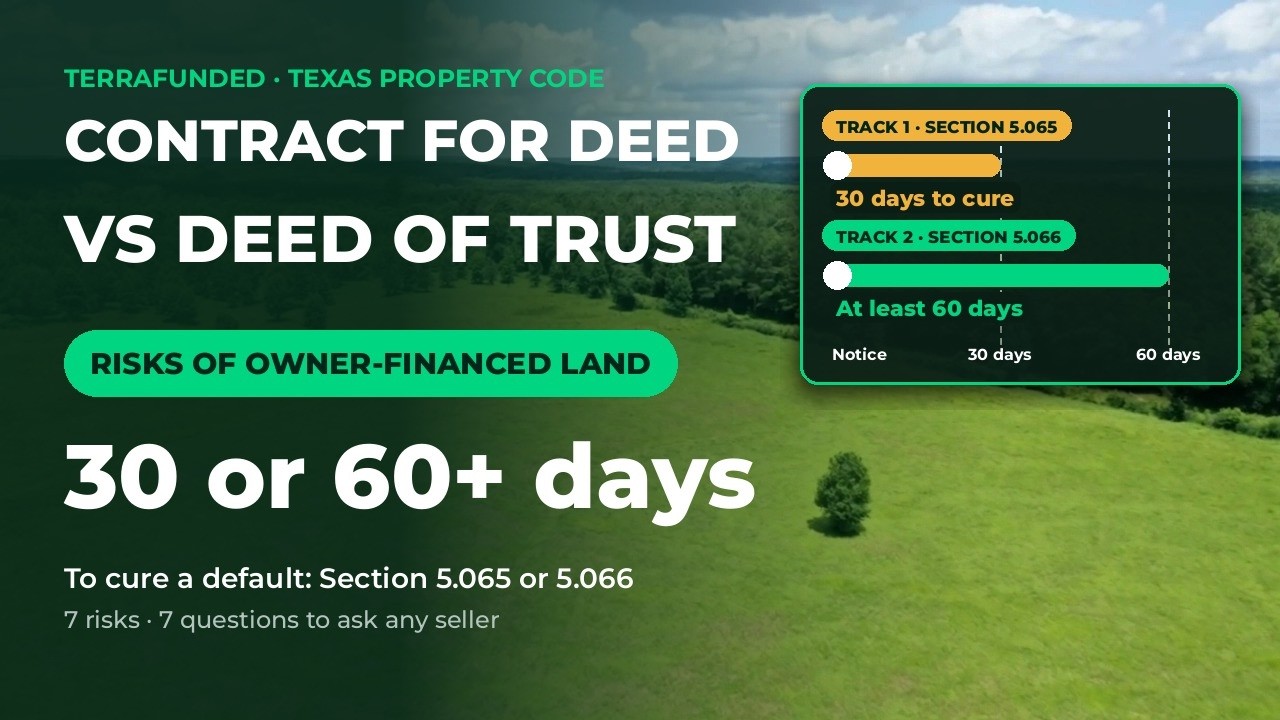
- If you default on a contract for deed, Section 5.065 gives you 30 days to cure; after 40% paid, 48 monthly payments or a recorded contract, Section 5.066 gives you at least 60 days and the seller can only sell through a trustee.
- Those contract-for-deed protections are written for land used as a residence (Section 5.062). For hunting or investment land, many may not apply.
- Ask any seller seven questions in writing before you pay. Our answers on one tract are below.
The structure: a deed or a contract
Two common structures are a deed with a deed of trust, and a contract for deed.
With a deed and a deed of trust, you receive the deed at closing and the seller holds a lien on the land, like a bank would. If you default, the seller has to foreclose under Section 51.002 of the Texas Property Code: written notice at least 21 days before the sale and, if the land is your residence, at least 20 days to cure first.
With a contract for deed, which the Property Code calls an executory contract, the seller keeps legal title while you pay. You do have rights under the contract, but you don't get the same legal title up front that a deed gives you. For a full comparison, see Warranty Deed vs contract for deed in Texas.
What the law gives contract-for-deed buyers
Subchapter D of Chapter 5 sets the rules for these contracts:
- Recording: the seller must record the contract within 30 days of signing (Section 5.076).
- A recorded contract counts as a deed with a vendor's lien (Section 5.079).
- A yearly statement: the seller must send you an account statement every year (Section 5.077).
- Spanish documents: if the deal was negotiated mainly in Spanish, you get the documents in Spanish (Section 5.068).
- Conversion: you can convert the contract into a deed and a deed of trust at any time (Section 5.081).
If you default, there are two different tracks:
| Track 1 | Track 2 | |
|---|---|---|
| Section | 5.065 | 5.066 |
| When it applies | Before the Track 2 thresholds | After 40% paid, 48 monthly payments, or a recorded contract |
| Time to cure | 30 days after written notice | At least 60 days after written notice |
| What the seller can do after | Cancel the contract and keep what you've paid | Sell only through a trustee, like a foreclosure |
The catch: it depends on what the land is for
Under Section 5.062, Subchapter D covers land used or to be used as the purchaser's residence, or a close relative's. Take three buyers:
- One buys to build a home and live there. The subchapter is written for that buyer.
- One buys to hunt on weekends.
- One buys to hold as an investment.
For the second and third buyer, many of these protections may not apply, and what they have is whatever their contract says. Other conditions matter too, so if you're offered a contract for deed, have a Texas real estate attorney read it before you sign.
Liens that come ahead of you
A lien that was on the land before your deal can outrank you. If the seller has a loan secured by the land and that lien stays in place after you buy, the lender can foreclose if the seller stops paying, and a foreclosure by a senior lien can wipe out your interest even when your own payments are current. It isn't automatic in every deal: it depends on which liens exist and on their priority.
- The title commitment lists the recorded liens and what must be paid off or released at closing.
- Section 5.016 requires a written notice at least 7 days before you sign when residential property will stay under a recorded lien, with exceptions.
- Property taxes work the same way. A tax lien comes ahead of other liens, so if the taxes go unpaid, the taxing units can foreclose even if you're current with the seller. Know who pays the taxes and check every year that they were paid.
No title company, no title insurance
Some owner-financed deals are signed at a kitchen table. A licensed title company searches the title, issues a title commitment on Texas form T-7, handles the money, closes and records the documents, and its owner's title insurance policy covers the title risks listed in the policy.
Know its limits: the policy has exceptions, and it doesn't tell you whether you can build on the land. But without a title search, a title problem can surface after years of payments. To see how a title-company closing works step by step, read how to buy owner-financed land in Texas, step by step.
The terms that hurt
Read the note before you sign it.
- A balloon payment is a large lump sum due before the end. If you can't pay it, you can lose the land.
- A variable rate can raise your payment.
- A prepayment penalty charges you for paying early.
- Compare the APR and the total of all payments, not just the monthly payment. Owner financing usually costs more than paying cash or using a bank.
- Your note can be sold. A seller can sell your note to another company; your terms stay the same, and you should get written instructions on where to send your payments.
Fraud
Vacant land is a favorite target for seller impersonation: in the National Association of Realtors' 2025 deed and title fraud survey, 62% of title fraud cases involved vacant land. Confirm the owner of record at the county, and send money only to a title company's escrow account, after you confirm the wire instructions by phone at a number you found yourself. Every check is in how to verify a Texas land seller.
Land with no legal access
You can hold a perfectly valid deed to land you can't legally reach. Legal access means the tract touches a public road, or has a recorded easement to one. A path across a neighbor's land isn't access unless it's recorded. Look for it in the survey and in the title commitment, and ask the county who maintains the road.
The land itself
On rural land, the physical risks can cost as much as the financial ones:
- Is there water, from a well or a water line, and at what cost?
- Will the soil take a septic system?
- How far is the power line?
- Is any of the tract in a floodplain?
- Do easements or restrictions limit where you can build?
The rural Texas land due diligence checklist covers each one, with free lookups and typical Texas costs.
Seven questions for any seller
Get the answers in writing, before you pay:
- What will I hold at closing, a deed in my name or a contract for deed, and will it be recorded?
- Are there any liens on this land, and how will they be paid off or released?
- Which title company closes it, and do I get an owner's title policy?
- What's the APR, the term and the total of all payments?
- Is there a balloon payment or a prepayment penalty?
- What happens if I'm late: the grace period, the late fee and the time to cure?
- How do I legally get to the land, and what do I need to know about its water, septic, power and flood risk?
A good seller answers all seven in writing.
How we answer them
Ask us the same seven. Here are our answers on the Olney tract in Young County, as of November 10, 2026:
| Question | Our answer on Olney |
|---|---|
| What you hold at closing | A Warranty Deed recorded in your name, with a deed of trust |
| Liens and title | A licensed Texas title company closes it, with an owner's title insurance policy |
| Price and cost | $99,000 cash or $118,800 financed: $5,940 down, then $1,213 a month for 180 payments at a 10% APR, fixed, about $224,200 in total |
| Balloon and prepayment | No balloon payment and no prepayment penalty |
| Access and utilities | Frontage on Highway 79, the power line along the road, no well or septic system yet |
The rest is in the Olney listing and in your documents, so read them. Prices change; the table below updates from our live inventory.
| Tract | County | Cash price | Financed price | Down payment | Monthly, 15 years | Monthly, 10 years |
|---|---|---|---|---|---|---|
| Wichita Falls (10 acres) | Clay | $98,000 | $117,576 | $6,000 | $1,199 | $1,474 |
| Olney (10 acres) | Young | $99,000 | $118,800 | $5,940 | $1,213 | $1,491 |
| Promised Valley (10 acres) | Young | $99,000 | $117,576 | $6,000 | $1,199 | $1,474 |
| Marshall (10 acres) | Harrison | $110,000 | $132,000 | $6,600 | $1,348 | $1,657 |
| Linden (10 acres) | Cass | $112,500 | $137,187 | $7,000 | $1,399 | $1,720 |
| Winnsboro (10 acres) | Franklin | $120,000 | $143,701 | $7,000 | $1,469 | $1,807 |
| Franklin 1 (10 acres) | Franklin | $120,000 | $143,701 | $7,000 | $1,469 | $1,807 |
| Titus (10 acres) | Titus | $120,000 | $137,187 | $7,000 | $1,399 | $1,720 |
| Lakeview (10 acres) | Titus | $122,400 | $146,993 | $7,500 | $1,499 | $1,843 |
| Moccasin (10 acres) | Coryell | $130,000 | $156,799 | $8,000 | $1,599 | $1,966 |
Questions we get every week
Is owner-financed land safe?
No structure removes every risk. A deed at closing through a title company reduces the title and ownership risks; it doesn't remove the financial risk, the access risk or the cost of utilities.
Is a contract for deed legal in Texas?
Yes, under the rules in Chapter 5, Subchapter D, of the Texas Property Code.
Can I lose the land if I stop paying?
Yes: through foreclosure or, under some contracts, cancellation, and you can lose what you've paid. See what happens if you stop paying on owner-financed land in Texas.
Do I need a lawyer?
It isn't required, but a Texas real estate attorney can review your documents before you sign.
Sources
- Texas Property Code, Chapter 5 (Sections 5.016, 5.062, 5.065, 5.066, 5.068, 5.076, 5.077, 5.079 and 5.081), official text read on November 10, 2026: https://statutes.capitol.texas.gov/Docs/PR/htm/PR.5.htm
- Texas Property Code, Chapter 51 (Section 51.002): https://statutes.capitol.texas.gov/Docs/PR/htm/PR.51.htm
- Texas Department of Insurance, form T-7 (title commitment): https://www.tdi.texas.gov/title/documents/form_t-07.pdf
- National Association of Realtors, 2025 Deed and Title Fraud Survey: https://www.nar.realtor/research-and-statistics/research-reports/deed-and-title-fraud-survey
- TerraFunded live inventory feed (Olney tract): https://terrafunded.com/api/properties.json, read November 10, 2026.
Want our written answers on any tract, or to see how a title-company closing works on a real one? Call or text Andy at (214) 306-8153. Se habla español.
This page is general information, not legal advice. Have a Texas real estate attorney review your documents before you sign.
Full video transcript
[0:01] What are the risks of owner-financed land in Texas? Seven to know. One: the structure, a deed with a deed of trust or a contract for deed, because it decides when you get legal title. Two: a lien that comes ahead of you, like the seller's own loan or unpaid property taxes. Three: no title company and no title insurance. Four: the terms, like a balloon payment or a variable rate. Five: fraud. Six: land with no legal access. And seven: the land itself, its water, septic, power and flood risk.
[0:42] Texas law adds buyer protections in Chapter 5 of the Property Code, but several of them depend on whether the land will be your home. In this video: each risk, what the law says, and seven questions to ask any seller, including us.
[0:58] This is TerraFunded, from Dallas. We've sold rural Texas land with owner financing since 2020, more than 350 transactions, and every one closes at a licensed title company.
[1:16] Two common structures are a deed with a deed of trust, and a contract for deed. With a deed and a deed of trust, you receive the deed at closing and the seller holds a lien, like a bank. If you default, the seller has to foreclose under Section 51.002 of the Property Code: at least 21 days' written notice before the sale, and if the land is your home, at least 20 days to cure first.
[1:47] With a contract for deed, which the Property Code calls an executory contract, the seller keeps legal title while you pay. You do have rights under the contract, but you don't get the same legal title up front that a deed gives you.
[2:08] Subchapter D of Chapter 5 sets the rules for these contracts. The seller must record the contract within 30 days of signing, and under Section 5.079, a recorded contract is treated the same as a deed with a vendor's lien. The seller must send you a statement every year. If the deal was negotiated mainly in Spanish, you get the documents in Spanish. And if you default, there are two different tracks.
[2:37] On the first, under Section 5.065, you get written notice and 30 days to cure; if you don't, the seller can cancel the contract and keep what you've paid. The second applies once you've paid 40% or made 48 monthly payments, or if the contract was recorded. Then, under Section 5.066, the seller has to give you at least 60 days to cure, and after that can only sell through a trustee, like a foreclosure.
[3:10] You can also convert the contract into a deed and a deed of trust at any time, under Section 5.081.
[3:23] Under Section 5.062, that subchapter covers land used or to be used as the purchaser's residence, or a close relative's. Take three buyers. The first buys to build a home and live there: the subchapter is written for that buyer. The second buys to hunt on weekends. The third buys to hold as an investment. For those two, many of these protections may not apply, and what they have is whatever their contract says.
[3:56] Other conditions matter too, so if you're offered a contract for deed, have a Texas real estate attorney read it before you sign.
[4:09] A lien that was on the land before your deal can outrank you. If the seller has a loan secured by the land and that lien stays in place after you buy, the lender can foreclose if the seller stops paying, and a foreclosure by a senior lien can wipe out your interest even when your own payments are current. It isn't automatic in every deal: it depends on which liens exist and on their priority.
[4:34] That's what the title commitment is for: it lists the recorded liens and what must be paid off or released at closing. For residential property that will stay under a recorded lien, Section 5.016 requires a written notice at least 7 days before you sign, with exceptions. Property taxes work the same way. A tax lien comes ahead of other liens, so if the taxes go unpaid, the taxing units can foreclose even if you're current with the seller.
[5:08] Know who pays the taxes, and check every year that they were paid.
[5:18] Some owner-financed deals are signed at a kitchen table. A licensed title company searches the title, issues a title commitment on Texas form T-7, handles the money, closes and records the documents, and its owner's title insurance policy covers the title risks listed in the policy. Know its limits: the policy has exceptions, and it doesn't tell you whether you can build on the land.
[5:44] But without a title search, a title problem can surface after years of payments. Want to see how a title-company closing works on a real tract? Andy can set up a visit any day of the week: call or text 214-306-8153.
[6:08] Read the note before you sign it. A balloon payment is a large lump sum due before the end, and if you can't pay it, you can lose the land. A variable rate can raise your payment. A prepayment penalty charges you for paying early. Owner financing usually costs more than paying cash or using a bank, so compare the APR and the total of all payments, not just the monthly payment.
[6:34] And know that a seller can sell your note to another company: your terms stay the same, and you should get written instructions on where to send your payments.
[6:48] Vacant land is a favorite target for seller impersonation: in a 2025 report from the National Association of Realtors, 62% of title fraud cases involved vacant land. Confirm the owner of record at the county, and send money only to a title company's escrow account, after you confirm the wire instructions by phone, at a number you found yourself. Our video on verifying a land seller walks through every check.
[7:22] You can hold a perfectly valid deed to land you can't legally reach. Legal access means the tract touches a public road, or has a recorded easement to one. A path across a neighbor's land isn't access unless it's recorded. Look for it in the survey and in the title commitment, and ask the county who maintains the road.
[7:49] On rural land, the physical risks can cost as much as the financial ones. Is there water, from a well or a water line, and at what cost? Will the soil take a septic system? How far is the power line? Is any of the tract in a floodplain? And do easements or restrictions limit where you can build? Our due diligence checklist video covers each one.
[8:21] One: what will I hold at closing, a deed in my name or a contract for deed, and will it be recorded? Two: are there any liens on this land, and how will they be paid off or released? Three: which title company closes it, and do I get an owner's title policy? Four: what's the APR, the term and the total of all payments? Five: is there a balloon payment or a prepayment penalty?
[8:53] Six: what happens if I'm late: the grace period, the late fee and the time to cure? Seven: how do I legally get to the land, and what do I need to know about its water, septic, power and flood risk? A good seller answers all seven in writing.
[9:19] Ask us the same seven. Here are ours on our Olney tract, in Young County, as of November 2026. A Warranty Deed at closing, with a deed of trust. A licensed Texas title company and an owner's title policy. $99,000 cash or $118,800 financed: $5,940 down, then $1,213 a month for 180 payments, at a 10% APR, fixed, about $224,200 in total. No balloon payment and no prepayment penalty. Frontage on Highway 79, the power line along the road, and no well or septic system yet.
[10:03] The rest is in the listing and in your documents, so read them.
[10:13] Is owner-financed land safe? No structure removes every risk. A deed at closing through a title company reduces the title and ownership risks; it doesn't remove the financial risk, the access risk or the cost of utilities. Is a contract for deed legal in Texas? Yes, under the rules in Chapter 5 of the Property Code. Can I lose the land if I stop paying? Yes: through foreclosure or, under some contracts, cancellation, and you can lose what you've paid.
[10:48] Do I need a lawyer? It isn't required, but a Texas real estate attorney can review your documents before you sign.
[10:57] So, the risks of owner-financed land in Texas come down to seven questions: what you hold at closing, the liens, the title company, the full cost, the balloon and prepayment terms, what happens if you're late, and the access and condition of the land. Get the answers in writing from any seller, including us, before you pay. The checklist is on our page at terrafunded.com.
[11:26] Or call or text Andy at 214-306-8153. Se habla español.
Page history
- : Published with the video: the seven risks, what Chapter 5 and Section 51.002 of the Texas Property Code say (read on November 10, 2026), the seven questions to ask any seller and our answers on the Olney tract. General information, not legal advice.
Related articles
- Best Websites for Owner-Financed Land in Texas: Where to Find It and How to Read the Listings
- What Do I Need to Buy Land in Texas With Owner Financing? Requirements, ITIN and Down Payment
- Owner Financed Land for Sale Near Dallas, Texas (2026): Drive Times and Prices
- Building a House on Rural Land in Texas (2026): Which Permits Are Required and Which Usually Are Not
- Closing on Owner-Financed Land in Texas, Step by Step: From Reservation to Your First Payment (2026)
- What "Unrestricted Land" Really Means in Texas (2026): Deed Restrictions, HOAs, County Rules and the ETJ