How Deep Are Water Wells in the Texas Hill Country? County by County, and What Changed in 20 Years
The median home well in the 10 Hill Country counties, the spread inside each county, the water level 20 years ago and now, and the groundwater rules that change at 10 acres.
Rodrigo Blanco, Founder & CEO of TerraFunded
Published: 2026-11-12 · Updated: 2026-11-12
Figures checked against our inventory on November 10, 2026.
How deep are water wells in the Texas Hill Country? Deeper than in most of Texas, and the county decides a lot. In the 10 Hill Country counties we compare, the typical home well drilled in the last 10 years runs from about 240 feet in Gillespie County to about 540 feet in Kerr County, from 11,262 wells in the state's own driller reports. And over 20 years, the water in new wells stands lower in 8 of those 10 counties.
This page covers which counties count as the Hill Country, the depth county by county, the spread inside each county, what changed in 20 years, the 10-acre line in the groundwater rules and how to look up any address yourself, free.
Watch the video
Chapters
In short
- Deepest: Kerr County, a median of 540 feet (955 wells). Shallowest: Gillespie County, 240 feet (1,959 wells, the most in the region).
- Spread: inside one county, wells can differ by hundreds of feet. In Medina, the middle half runs from 344 to 820 feet.
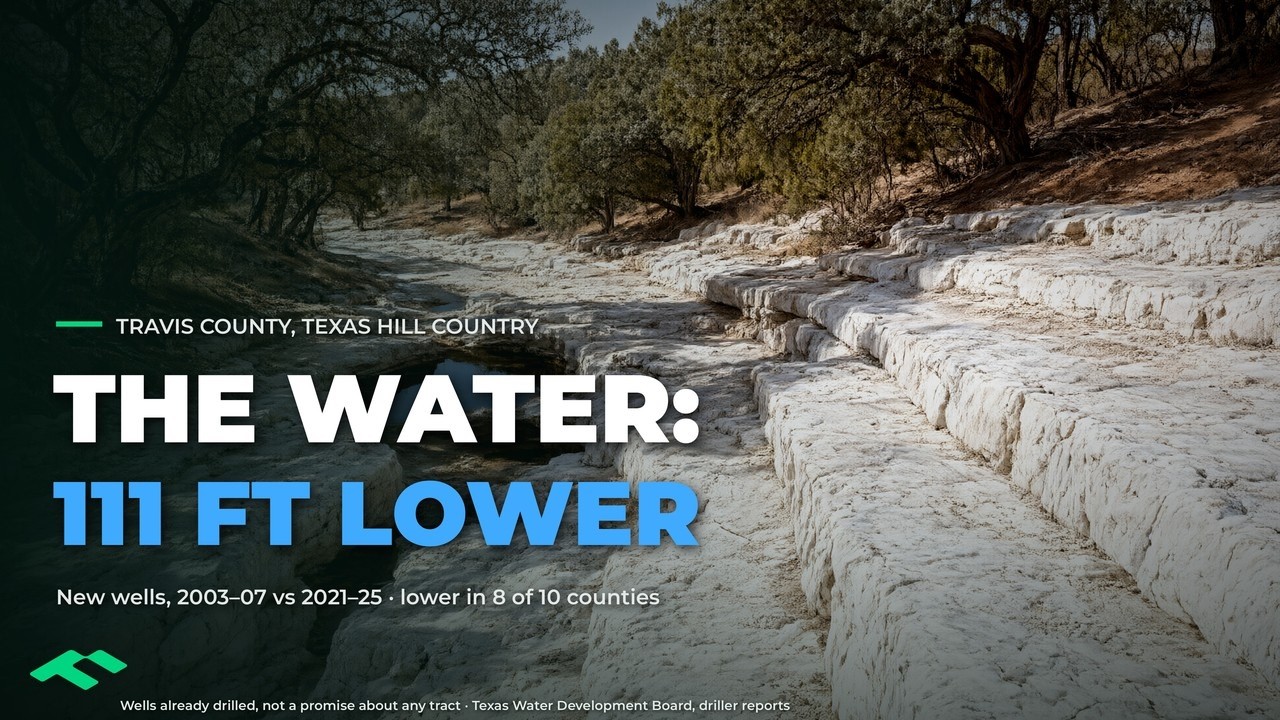
- 20 years: Kerr, Blanco and Bandera drill clearly deeper. The water stands clearly lower in 8 of 10 counties, most of all in Travis (111 feet lower).
- Rules: every one of these counties has a groundwater district or authority, and several draw a line at 10 acres.
- Cost: by our estimate, a complete well runs roughly $8,500 to $21,000 at Gillespie's median and roughly $16,000 to $39,000 at Kerr's. The real price comes from a driller's quote.
Which counties, and where the numbers come from
"Hill Country" means different things to different people, so we use the state's definition: the counties with home wells inside the Texas Water Development Board's groundwater model of the Hill Country part of the Trinity Aquifer. That's 10 counties: Bandera, Bexar, Blanco, Comal, Gillespie, Hays, Kendall, Kerr, Medina and Travis.
Every time a licensed driller finishes a well in Texas, they file a report with the state. Our free Texas Well Atlas reads that file every night. We count home wells, new or replacements, finished in the last 10 years, and we give the median, the middle well. These are wells other people drilled, not a promise about any tract.
County by county
| County | Median depth (feet) | Middle half (feet) | Home wells |
|---|---|---|---|
| Kerr | 540 | 380 to 660 | 955 |
| Medina | 535 | 344 to 820 | 800 |
| Bandera | 510 | 450 to 640 | 1,042 |
| Hays | 510 | 410 to 680 | 1,086 |
| Bexar | 500 | 360 to 694 | 810 |
| Comal | 484 | 400 to 600 | 1,255 |
| Travis | 445 | 280 to 628 | 969 |
| Kendall | 413 | 280 to 570 | 1,214 |
| Blanco | 410 | 305 to 505 | 1,172 |
| Gillespie | 240 | 178 to 367 | 1,959 |
Source: Hill Country finding, state file of November 10, 2026. Each county has its own page in the Atlas, like Kerr County or Gillespie County.
The spread inside each county
The median isn't the whole story. In Medina County, the middle half of home wells runs from 344 to 820 feet. In Travis, from 280 to 628. In Kendall, from 280 to 570.
Two wells a mile apart can reach water at very different depths, so look at the wells closest to the land you're considering, and at the most recent ones.
What changed in 20 years
We compared the wells finished in 2003 to 2007 with those finished in 2021 to 2025.
Depth. Three counties now drill clearly deeper: Kerr, from 480 to 560 feet (17% more); Blanco, from 364 to 420 (15% more); and Bandera, from 480 to 530 (10% more).
Water level. It's measured once, when each well is finished, and it says more:
| County | Water level change, 2003 to 2007 vs 2021 to 2025 |
|---|---|
| Travis | 111 feet lower (214 feet then, 325 now) |
| Medina | 69 feet lower |
| Kerr | 66 feet lower |
| Blanco | 51 feet lower |
| Hays | 47 feet lower |
| Bandera | 40 feet lower |
| Comal | 30 feet lower |
| Gillespie | 18 feet lower |
| Bexar, Kendall | No clear change |
Two cautions. 2022 and 2023 were dry years in much of Texas, and that pulls the level down. And a deeper well can mean a falling water table, a different aquifer, better water or simply more reserve. For the whole state, see our 20-year study.
The 10-acre line in the groundwater rules
In the Hill Country, every one of these counties has a groundwater district or authority, and several draw a line at 10 acres. Our free county rules map shows each one with its official source.
- Kerr: a home or livestock well is exempt from a permit if it's on a tract of 10 acres or more and can't produce more than 25,000 gallons a day, and every exempt well must be registered.
- Kendall: the Cow Creek district exempts home and livestock wells only on tracts larger than 10 acres.
- Bandera: if the tract is under 10 acres, the well needs a permit.
- Gillespie: every well must be registered before drilling, and registering an exempt well costs $100.
Rules change, so check with the district before you call a driller. For the state exemption, see do you need a permit to drill a water well in Texas.
Look up any address
Open the Texas Well Atlas and type an address. You'll see the wells nearest to it: how deep they went, where the water stood, how much they gave, and a link to each official report.
Before you buy land in the Hill Country, look at the recent wells around it, ask a local driller and check the district.
Questions we get every week
How deep are water wells in the Texas Hill Country? From about 240 feet in Gillespie County to about 540 in Kerr, in the median of the last 10 years.
Which county has the deepest wells? Kerr, with a median of 540 feet.
Is the water dropping? In new wells, it stands clearly lower than 20 years ago in 8 of the 10 counties, most of all in Travis.
Do I need a permit for a home well? Every county here has a groundwater district or authority, and several rules change at 10 acres.
How much does a well cost? By our estimate, roughly $8,500 to $39,000 at the county medians. The real price comes from a driller's quote.
Sources
- Texas Water Development Board, Submitted Driller's Reports database: https://www.twdb.texas.gov/groundwater/data/data-well-reports.asp
- TWDB, well report viewer: https://www3.twdb.texas.gov/apps/WaterDataInteractive/GroundwaterDataViewer/?map=sdr
- TWDB, groundwater availability models (Hill Country part of the Trinity): https://www.twdb.texas.gov/groundwater/models/gam/index.asp
- TerraFunded, Texas Well Atlas dataset (Zenodo): https://doi.org/10.5281/zenodo.24126380
- The finding behind this page, with the table as a CSV: https://terrafunded.com/wells/findings/texas-hill-country-water-well-depth
The figures come from the state file of November 10, 2026, and the Atlas recalculates them every night. They describe wells already drilled, not a promise about any tract. The cost ranges are a TerraFunded estimate, not a quote. The tables are free to use with credit under CC BY 4.0.
Full video transcript
[0:01] How deep are water wells in the Texas Hill Country? Deeper than in most of Texas, and the county decides a lot. In the 10 Hill Country counties we compare, the typical home well drilled in the last 10 years runs from about 240 feet in Gillespie County to about 540 feet in Kerr County. That's from 11,262 wells in the state's own driller reports. And over 20 years, the water in new wells stands lower in 8 of those 10 counties. In this video: where the numbers come from, county by county, what changed in 20 years, the 10-acre line in the groundwater rules, and how to look up any address yourself, free.
[0:46] This is TerraFunded, from Dallas. We sell rural Texas land, and we built the Texas Well Atlas, free, from the state's own well reports.
[1:02] "Hill Country" means different things to different people, so we use the state's definition: the counties with home wells inside the Texas Water Development Board's groundwater model of the Hill Country part of the Trinity Aquifer. That's 10 counties: Bandera, Bexar, Blanco, Comal, Gillespie, Hays, Kendall, Kerr, Medina and Travis. Every time a licensed driller finishes a well in Texas, they file a report with the state.
[1:33] We count home wells, new or replacements, finished in the last 10 years, and we give the median, the middle well. These are wells other people drilled, not a promise about any tract.
[1:51] The deepest is Kerr County: a median of 540 feet, with the middle half from 380 to 660, from 955 wells. Then Medina, 535 feet; Bandera and Hays, 510; Bexar, 500; Comal, 484; Travis, 445; Kendall, 413; and Blanco, 410. The shallowest is Gillespie: 240 feet, with the middle half from 178 to 367. Gillespie also drills the most, with 1,959 home wells. By our estimate, a complete well runs roughly $8,500 to $21,000 at Gillespie's median, and roughly $16,000 to $39,000 at Kerr's. The real price comes from a driller's quote.
[2:58] The median isn't the whole story. In Medina County, the middle half of home wells runs from 344 to 820 feet. In Travis, from 280 to 628. In Kendall, from 280 to 570. Two wells a mile apart can reach water at very different depths, so look at the wells closest to the land you're considering, and at the most recent ones.
[3:34] We compared the wells finished in 2003 to 2007 with those finished in 2021 to 2025. Three counties now drill clearly deeper: Kerr, from 480 to 560 feet, 17% more; Blanco, from 364 to 420, 15% more; and Bandera, from 480 to 530, 10% more. The water level says more. It's measured once, when each well is finished, and it stands clearly lower in 8 of the 10 counties. The biggest change is in Travis County: the water settled at 214 feet then, and at 325 now, 111 feet lower. In Medina, 69 feet lower; in Kerr, 66; in Blanco, 51; in Hays, 47; in Bandera, 40; in Comal, 30; and in Gillespie, 18. In Bexar and Kendall, there's no clear change.
[4:44] Two cautions. 2022 and 2023 were dry years in much of Texas, and that pulls the level down. And a deeper well can mean a falling water table, a different aquifer, better water or simply more reserve.
[5:07] In the Hill Country, every one of these counties has a groundwater district or authority, and several draw a line at 10 acres. Our county rules map, free at terrafunded.com/counties, shows each one with its official source. In Kerr County, a home or livestock well is exempt from a permit if it's on a tract of 10 acres or more and can't produce more than 25,000 gallons a day, and every exempt well must be registered.
[5:36] In Kendall, the Cow Creek district exempts home and livestock wells only on tracts larger than 10 acres. In Bandera, if the tract is under 10 acres, the well needs a permit. In Gillespie, every well must be registered before drilling; registering an exempt well costs $100. Rules change, so check with the district before you call a driller.
[6:08] Open terrafunded.com/wells and type an address. You'll see the wells nearest to it: how deep they went, where the water stood, how much they gave, and a link to each official report. Every county has its own page, and this comparison is on our findings page, with a table you can download. Before you buy land in the Hill Country, look at the recent wells around it, ask a local driller and check the district.
[6:45] How deep are water wells in the Texas Hill Country? From about 240 feet in Gillespie County to about 540 in Kerr, in the median of the last 10 years. Which county has the deepest wells? Kerr, with a median of 540 feet. Is the water dropping? In new wells, it stands clearly lower than 20 years ago in 8 of the 10 counties, most of all in Travis. Do I need a permit for a home well? Every county here has a groundwater district or authority, and several rules change at 10 acres.
[7:22] How much does a well cost? By our estimate, roughly $8,500 to $39,000 at the county medians; the real price comes from a driller's quote.
[7:34] So, how deep are water wells in the Texas Hill Country? From about 240 to about 540 feet in the county medians, and the water in new wells stands lower than 20 years ago in most counties. Look up any address free at terrafunded.com/wells, and check the rules at terrafunded.com/counties. The tables are free to use with credit. In Spanish, it's all at terrafunded.com/es/pozos.
Page history
- : Published with the video, its chapters and the full transcript, and the county tables from the Texas Well Atlas findings (state file of November 10, 2026).
Check the water before you buy
Free TerraFunded tools, built on the driller reports filed with the state and the TWDB groundwater models. No sign-up.
- Texas Well Atlas: the real wells near any address and in all 254 counties
- Well water quality: arsenic, nitrate, fluoride and salts in the tested wells of each county
- Underground: the aquifer layers under any point, in 3D
- Well depth by city and town
- Texas groundwater districts
- Well, septic and power rules in all 254 counties
Related articles
- Buying Land at a Texas Tax Sale: Redemption, Liens and Title Risk
- Buying Land in Texas With Cash: Title, Survey, Safe Wires and Closing Costs
- Do I Need a Lawyer to Buy Land in Texas? When One Is Worth It
- How Deep Are Water Wells Around Dallas-Fort Worth? County by County, From 20 Years of State Reports
- Can You Live Off-Grid in Texas? What's Legal, Water, Wastewater, Power and the Real Cost
- What Can You Do With 10 Acres in Texas? The Rules That Change at 10 Acres